MIDI and Garage Band

This is my first tinkering with the Midi file

As mentioned in an earlier post, Yo-Yo Ma’s iece is good to use but not good to edit.

One way to go around this is to find a MIDI recording of Bach’s Cello suite No 1.

Overview of MIDI

From https://blog.landr.com/what-is-midi/ :
“MIDI is a communication standard that allows digital music gear to speak the same language.

MIDI is short for Musical Instrument Digital Interface. It’s a protocol that allows computers, musical instruments and other hardware to communicate.

MIDI was first developed in the early 80s to standardize the growing amount of digital music hardware.

Manufacturers needed a simple way to make their products compatible with those of other brands.

Roland founder Ikutaro Kakehashi proposed the idea of a standard instrument language to the other major manufacturers, including Oberheim, Sequential Circuits and Moog, in 1981.

The project had some lofty goals. MIDI attempted to provide a way to communicate all the features of a musical performance digitally.

The architects of the MIDI standard had to define all kinds of complex musical behaviour in a way that 1980s-era technology could work with—not an easy task.

Their choices had big consequences for the way electronic instruments were designed for the next 40 years.

The finished MIDI standard was finally unveiled in 1982. Kakehashi and Dave Smith both later received Technical Grammy Awards in 2013 for their key roles in the development of MIDI—about time!”

So if I can get my hands on a MIDI recording of the Cello Suite I’d have a greater sense of freedom to be creative.

Getting my MIDI file

With a simple google search I found:

http://www.jsbach.net/midi/midi_solo_cello.html

I am interested in the Prelude.

Opening up the MIDI file

I imported the file to Garageband. The good thing about Garageband is that it builds upon technologies of Logic Pro X while staying not too technical. You can call it semi-amateur. You can call it semi-pro.

, Opening up the file in Garageband

Listen to this here.

Editing this recording

While this recording is correct, it lacks the emotional cues and dynamics.

My work in this part is to edit this recording.

I particularly enjoy listening to the first 4 bars looped.

Further modifications are needed to the notes encoded in the MIDI file before I can use it effectively in Garageband.

First 4 bars rearranged in Garageband

This rearrangement enables me to apply Arpeggiators and other sorts of nice effects.

Rearrangement 1

This is my first tinkering with the Midi file

Choice of music

Tackling my schezophonia project head – on without dividing it into sub-pieces can get too messy. I will go through it in a divide and conquer manner. This means that I divide a seemingly complecated task into a series of “simple” parts.

First things first let’s go through my thought process for the music.

Needs

The piece of music needs to fulfill a number of conditions. Namely:

  • Be soothing to me
  • Be famous enough to have online support from the open source community
  • Have a wealth of usable musical information

Possible contenders

Schubert’s Ave Maria

This piece is soothing to me. I believe it’s famous because I hear it in most settings: movies, series, concerts…

It has well formed and exact chords.

A problem I found with this is that it has a christian background. When discussing the revolution in Lebanon it’s not suitable. One of the points of the revolution is the secular nature of a technocratic regime being put forward.

Bach’s cello suite No 1 in G major

Looking for something that I have a history of listening to and I get soothing from is relatively easy. The hard part is ensuring that it fulfills the other conditions.

This Piece is really famous. I stumbled upon it in most my violin/Music theory/Music harmony classes.

The basis of this piece is the multitudes of chords arranged in arpeggios.

So far so good.

2 problems came up:

  • I can only download the recording as an MP4 file. so I won’t be able to input it to a DSP software.
  • I am using Yo-Yo ma’s performance. This artist is well-known for his freedom in the rhythm used. So sampling will become harder.

Conclusion

The choice of music is done, I need to find alternative recordings

Dadaism and absurdity

Dada was an artistic and literary movement that began in Zürich, Switzerland. It arose as a reaction to World War I and the nationalism that many thought had led to the war. Influenced by other avant-garde movements, its output was wildly diverse, ranging from performance art to poetry, photography, sculpture, painting, and collage. Dada’s aesthetic, marked by its mockery of materialistic and nationalistic attitudes, proved a powerful influence on artists in many cities, including Berlin, Hanover, Paris, New York, and Cologne, all of which generated their own groups. The movement dissipated with the establishment of Surrealism, but the ideas it gave rise to have become the cornerstones of various categories of modern and contemporary art.

https://www.theartstory.org/movement/dada/

It arose in the disgust of the social and political dimensions

Marcel Duchamp

A popular work of Marcel Duchamp is The Bride Stripped Bare by Her Bachelors, Even (La mariée mise à nu par ses célibataires, même)

It’s an artwork over 9 feet tall, and freestanding. Duchamp created two panes of glass with materials such as lead foil, fuse wire, and dust. It combines chance procedures, plotted perspective studies, and laborious craftsmanship.

He conveyed the complicated relationships between males and females

Watch the work in action here

Relaying absurdity

Just like WWI’s conflicts altered how the generation saw the world, the ‘Series of Unfortunate Events’ that I’d mentioned earlier changed mine.

My step in relaying my outlook

  • Make a clear schism between the aural and the visual queues.
  • Use periodicity.
  • Alter the music electronically to ensure different sound characters.

After thoughts

Looking around for inspiration makes me better define my project 1.

My Schizophonia project definition

You are to consider the possible relationships between the aural phenomena associated with all things in particular contexts that you devise.

CAEL2041 project 1. ‘Schizophonia’

We need to make one project that uses the same recording and alters its perception by the context used.

The choice of medium used is free. We can choose any medium that suits best the project. The main aim isn’t how technical we get with the project. Rather, we care about the concept.

Thinking of sounds that change in perception but automatically reminds me of comedy. Serious sounds such as gunshots or door slams become funny in a “funny” context.

My project

Let’s unwrap the previous idea and make it abstract. We get this statement:

A **insert adjective here** sound in a **insert adjective here** context, makes a **insert adjective here** effect.

Implementing a sound in an artistic context might imply using parts of my life, my journey.

The past two years were filled with very big challenges. However I managed to act with calmness. This particular dissonance makes the world look absurd to me. I am looking for outputting this absurdity through this project.

An abstract definition

Get a recording of a live, soothing performance.

Keep the audio running while showing different happenings since 2017.

The events

The events that happened since 2017 were (in order)

  • 2017 I had a traumatic accident followed by a coma
  • 2018 I stayed on a wheelchair for more than a year
  • 2019 A revolution started in Lebanon
  • 2020 I went on exchange to Sydney. As soon as I arrived wildfires started, A big flood happened and to top it off, the big spread of the Coronavirus hit the news

How to convey this absurdity?

Taking one soothing musical piece and editing an overlay of text, some footage and photos. The effect will be made when the music doesn’t get affected.

This project is inspired by the dadaism art movement that started in 1915 in Europe after WW1

A soothing sound in a distressed context, makes an absurd. effect.

Naming

One of my favourite shows is “a series of unfortunate events”. It’s grim. I feel that this naming would accentuate the absurdism.

3D Printed Speaker?

At the end of week one, I thought that we had to bring with us an object that had to do with sound.

I got excited because this is a challenge to do something physical and relates to sound.

This had many constraints:

Constraints

  • Do something physically fine, yet feasible with the tremors I am trying to get rid of.
  • Let it be “natural”. No batteries, no electronics, no MIDI controllers or any other jargon.
  • Aesthetics. Something that LOOKs good will give the illusion that it SOUNDs better.

Now that these three constraints are put, it paradoxically easier for me to search.

I searched “3d printed sound” , as if 3D printing and audio output is feasible. But I tried, and good thing I did!

I found a lot of interesting, open source models. But here is what I stuck to:

The speaker

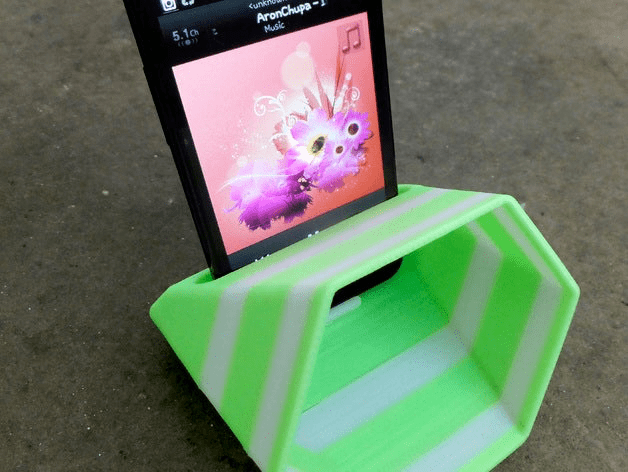
On https://www.thingiverse.com/thing:603596 i found a nice looking speaker.

A clean and simple amplifier for your mobile phone.

https://www.thingiverse.com/thing:603596

Here is a picture of what’s intended.

https://www.thingiverse.com/thing:603596

Some background

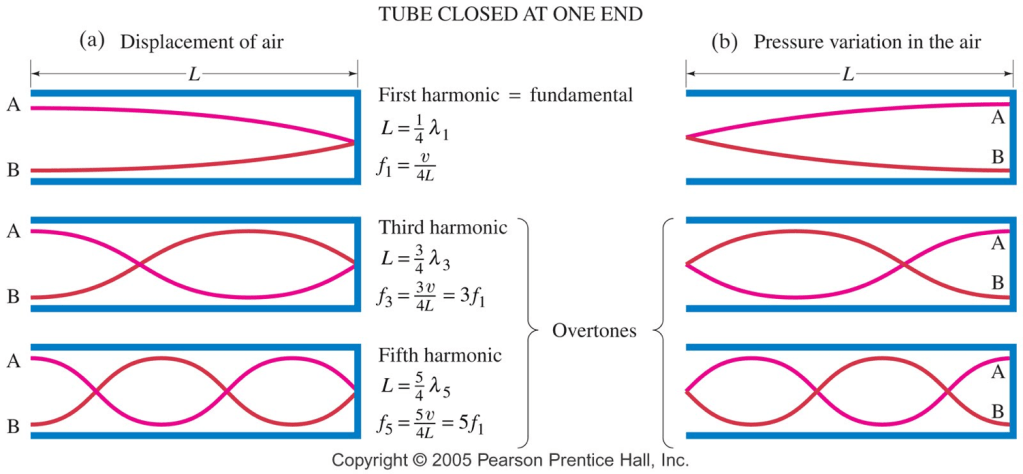
Although I didn’t have enough time to examine this in a mathematically rigorous way, this design looks very much like a sound pipe.

Image taken from the slides of Prof. Mihran Gurunian.

I didn’t really do the mathematics. But it’s somewhat apparent that the high frequencies (e.g. sound of human voice) will tend to get amplified.

This will work with the concept of constructive interference.

A constructive interference occurs when identical   signals are in phase and add up to each other.

Slides of Prof. Mihran Gurunian

Getting it done

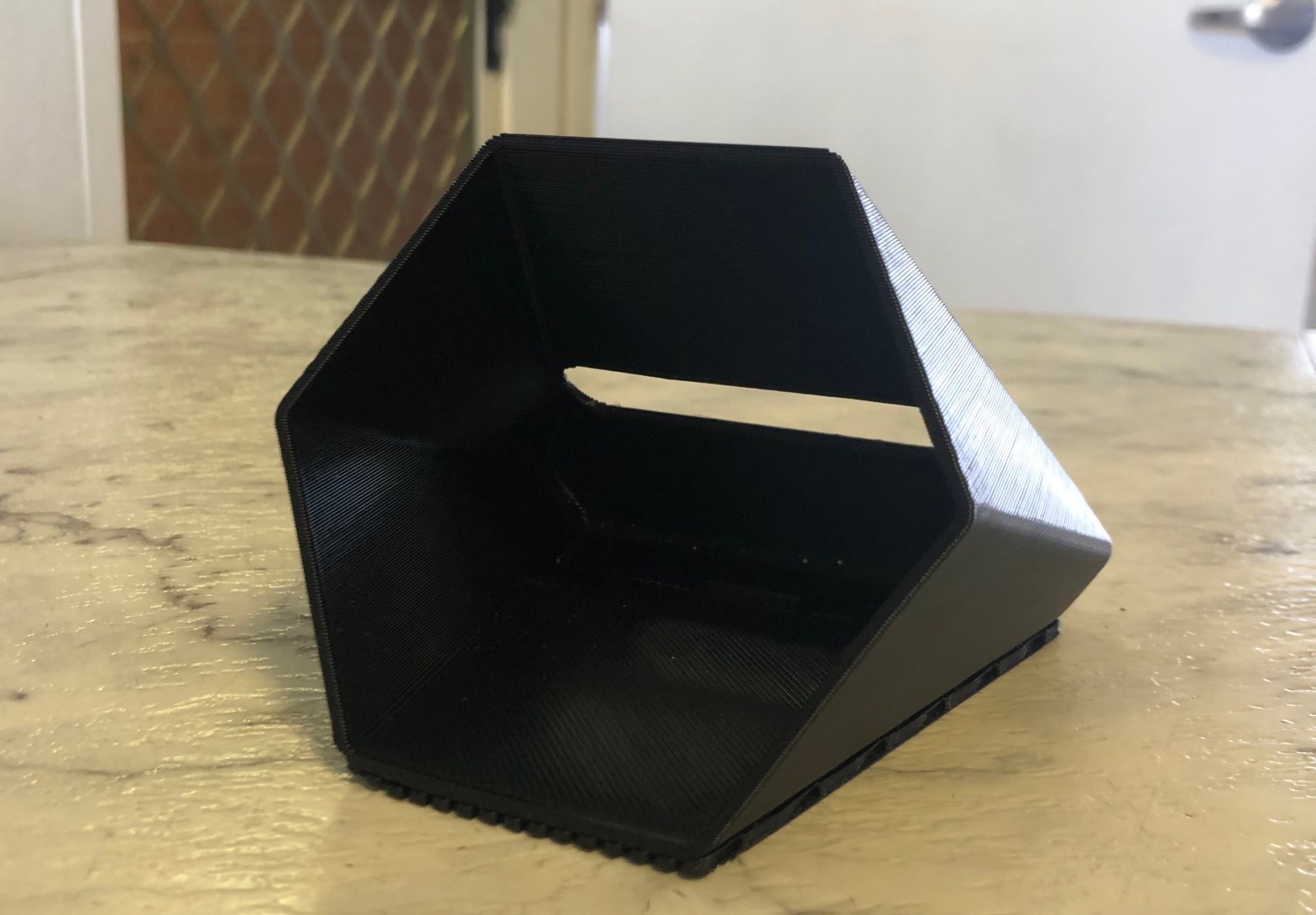
The final step is just applying this 3D model physically.

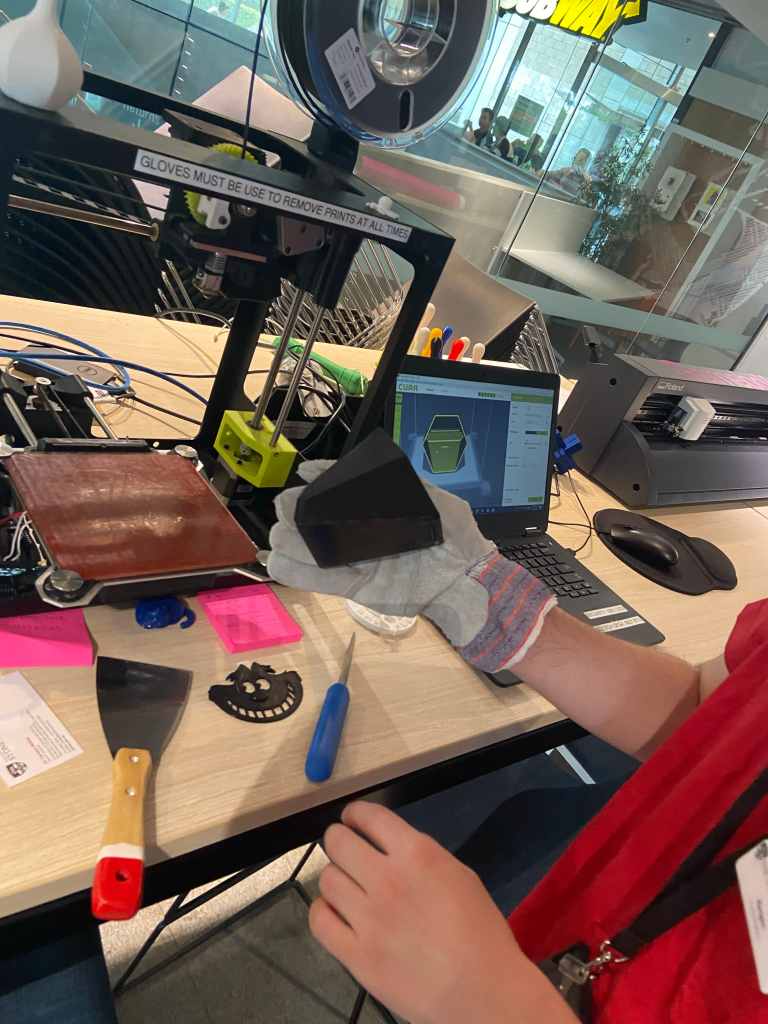
I took an appointment in the ThinkSpace Library.

I chose black for Aesthetic reasons. I also chose the most DENSE material to reflect lower frequencies

The print job only took 3 hours.

Make sure you watch the video demo.

Cheers.

Chadi Abi Fadel

Who am I?

Starting a blog during my learning experience can be a great way for me to have snapshots of my thought process during this.

Why do this?

  • First thing, it’s a requirement from my unit
  • Most importantly, I believe that any class is a collective experience fragmented into many individual ones. Having mine documented is a great way of making this class open-ended.

My training in an Engineering major and the fact that I practiced the violin for more than fifteen years will take the knowledge of this class to interesting places.

Create your own website, free on WordPress.com.Create your own website.
Start free