Featured

Project 2: Instrument/Instrumental

For the second project, I took a different logic than the first one. This time, the development and implementation was multi-dimensional.

Let’s start:

Development

Project statement

This project will begin by expanding and interrogating the idea of an instrument

Project 2 statement

This expansion and interrogation may or may not fit the classical definition of ‘instrument’.

My statement

I will use the software Sonic Pi that enables me to use my computer keyboard as a musical instrument. Sonic pie makes music by interpreting text inputted. After I learn it, I will explore some sonic illusions with it.

This form of music Instrumentation is niche. For my inspirations, I based my work off of Sam Aaron, the creator of Sonic Pi. I will do covers of minimalist electronic music, N’TO is a second inspiration. Looking further into the computer keyboard, looking at typists, their techniques and hardware is a good precedent when interacting with text.

In a nutshell, the process is based on inputting letters. The challenge throughout the project was finding the right ideas that get translated into the right strings of letters.

Sam Aaron

Sam Aaron is the creator of Sonic Pi. I wrote about him a nice article. Click here to read it.

One this to take from his talk and the concept of sonic pi is the concept of programming in and of itself can be used for self expression; especially when it comes to explaining a process.

Here is a video of Sam Aaron performing an electronic live set:

Typists and typing techniques

A typist is an administrative professional who completes transcripts and other typing tasks to enable the creation of printed or electronic documents. A typist is someone who provides electronic or hard-copy typed documents at the request of an employer or hiring organisation.

https://myjobsearch.com/careers/typist.html

One fascinating thing about a good typist is his mind boggling speeds in typing a document.

This is the video of the Ultimate Typing Championship Final 2010 By Das Keyboard. Skip to minute 2:00 to see the typists in action.

Seeing crazy fast times like 200 words/min made me question what they are doing differently. It turned out to be a combination of two factors.

  • The kind of keyboard
  • The technique used which is called touch typing.

I put it upon myself to actually train on that technique on https://www.typingclub.com. This got my speeds up from 13 words/minute to 40 words/minute, as of today. Yes you read it right 40.

The keyboard

The keyboard is one of the roots of the choice of this project.

My life for the past three years has revolving mainly around it. I was on a wheelchair and it was hard for me to walk. To contact a professor I sent him an email. The examples can go forever.

For the future, I believe that my work energy will be channeled through the keyboard.

Here is a post about its particular importance to me

Finding alternatives to the classic keyboard that may have problems sounds like a good Idea to achieve higher speeds.

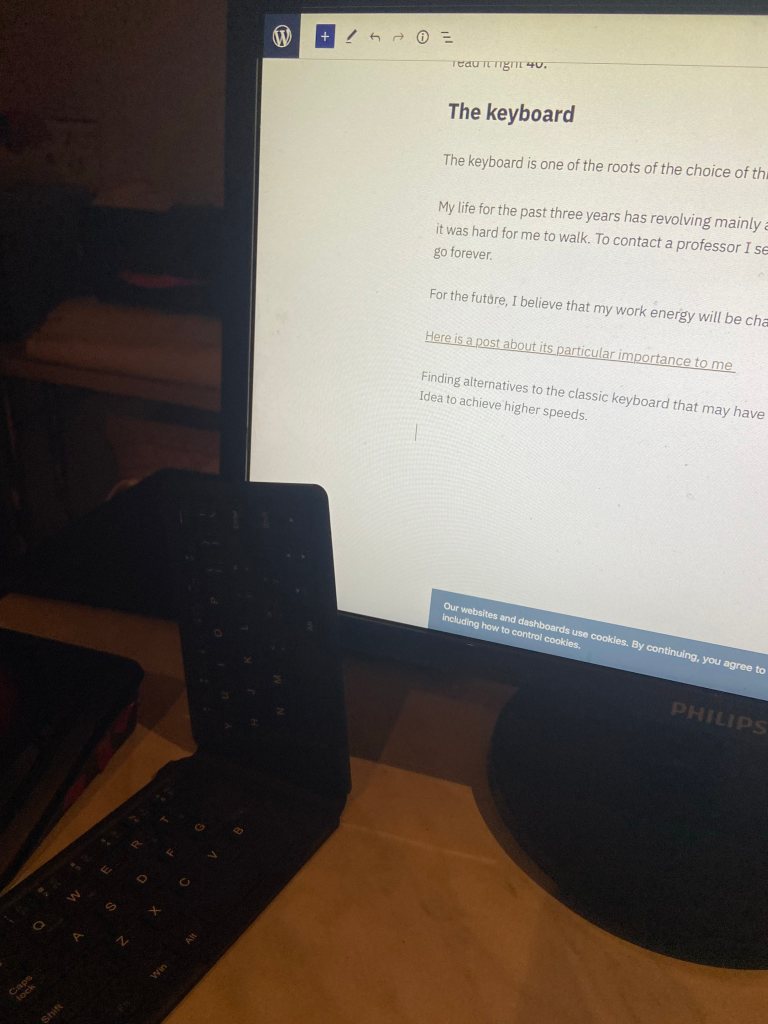
I bought a foldable bluetooth keyboard. It is ergonomic: the button placement is optimized for the technique on typingclub.com. The buttons on it are easy to press.
Further development

Sonic Pi crash course

Part of the development of the project and before I can look for individuals and products I can get inspired by, I went on to learn the abilities and the limitations of Sonic Pi as an instrument.

In a list of two items:

  • Sonic Pi helps me play. minimalistic electronic music
  • Sonic Pi, with its programmatic approach to sound, helps in coding sonic illusions

Some of the concepts taught, such as data structures, I learned from my years at the American University of Beirut.

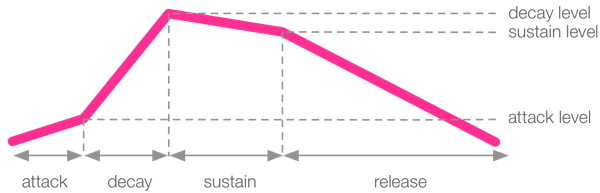
One useful functionality in Sonic Pi is the ease at which I can code ADSR envelopes in synths
I write about synths here.

I write about Samples here.

I use this little background to actually get my first hand experience in Sonic Pi.

Here is a post in which I get a first hand experience

Inspiration

Now that I have working experience with Sonic Pi, it is easier for me to work on projects by other artists I’m interested in and to actually give it a Sonic Pi spin.

The first inspiration is a music artist. DJ N’TO performs electronic music. His performances can be characterised by a great deal of minimalism.

Other inspirations came from sonic illusions. Namely the tritone paradox that I identified as being a name used for 2 different Illusions.

Implementation

Sonic Pi as a replacement for my violin

First I tried to use Sonic Pi to fulfil things I could do with my violin. The covers uses a nice system where I coded different actors of an orchestra: rhythm maker, chord chooser and different instruments.

This system tells Sonic Pi what note to play when exactly. The what and the when are 2 key components of a musical piece.

I wrote about this system here.

Now that I have a system all set up for work, I can do some covers of songs. I made a cover of Clé des Champs by N’TO.

Sonic pi irrespective of my violin

I also used sonic Pi for sound illusions. This would have been something I would have used it for whether or not I played the violin.

Ever-increasing paradox

This is the paradox where you feel that a sound is always increasing in pitch.

Here I implement it with three tritone pairs.

Please read the thought process here.

I then worked on extended 6 pair version for a smoother effect.

Read about it here

‘is it going up or down?’ paradox

A computer generated tritone going up is played on many different octaves. some listeners think it’s going up and others think it’s going down

Rethinking tritones

Both illusions use a tritone as a basis, this might imply that there is something particular about the tritone. Maybe magical. But is there?

I delve into this question In this post.

My experience with the violin as a means of generating ideas

So far, we have been looking at both instruments as being mutually exclusive. I looked back at me playing the violin to help me answer the question: “is there anything inherently special about the tritone?

Here I write about it

In this video I do the “is it going up?” paradox with an exact fourth on the violin.

So this paradox doesn’t have to be with a tritone, or does it?

to start, I tried changing the base note

Here is a post outlining this process

Now for my personal favourite a “tritone paradox” with random intervals

Here is a post explaining how I accomplished it

My CABI2532 folder on dropbox

Don’t forget to check the cabi2532 folder on dropbox.

Featured

Project 1 – Schizophonia

Now that I am done working on the project , here is a Summary Post

Development

Project definition

You are to consider the possible relationships between the aural phenomena associated with all things in particular contexts that you devise.

CAEL2041 project 1. ‘Schizophonia’

I talk about this more in this post.

Project statement

My concept is to relay absurdism through a split between “reality” of the world around me and my Reality. I chose multiple  recordings of Bach’s Cello Suite. As soothing music plays, I show different footage of the events that happened in the past three years; through appropriation and recontextualisation. I am not stating that I had anything to do with Bach’s piece. Philip Brophy is one of the artists that worked in this. I also used concepts that resonate with Dadaism.

The process used is GarageBand and iMovie. I took the liberty of taking a MIDI record and restructuring them to make a rather 2020 feel to it.

For my final step, I took my project online, assessing the comments given. (Youutube, Facebook , WhatsApp and Instagram)  

Dadaism and absurdity

Another artist that inspired me in the way he relates absurdity is Marcel Duchamp.

I posted about Dadaism here.

Implementation

Music

Choice of music

I needed to choose one piece with different recordings. Bach Cello suite.

In This post, I laid down the factors that made me choose it:

  • Be soothing to me
  • Be famous enough to have online support from the open source community
  • Have a wealth of usable musical information

Further edits and repetitiveness effect

I Edited a different MIDI recording in Garage band. I took the first 4 bars and looped them over and over again. This would amplify the effect I am looking for. This is a post going over this process.

This is my first tinkering with the Midi file

With further adjustments that were shown here, I came to my final audio.

these adjustments had three main conditions:

  • Make it Periodic for absurdism
  • Let go up and down and alternate between sounds
  • Maybe add a drummer?

This left me with the final version of the audio.

Movie

Script

I’m done with the music at that point. I need to start on the movie. I jotted down a broad script:

Getting footage

I’d categorised my footage into buckets that divide the footage into years. I neatly organised them into folders to make the work easier.

Putting things together

In iMovie, I reorganised the footage. made it work with the audio.

I also made one longer version for Youtube and another, shorter one for Instagram.

Here I write about this

Audience

So far, we have looked at the “particular contexts that you devise”.

Let’s see where I goes with contexts I don’t devise.

In the telecom industry a message has three components :

  • The sender: this is the person or device that is sending the message
  • The medium: this is the means for transmitting the message. This is where the most technical part. i.e. cables for a landline phones, sound and air for musicians, Video for movie makers…
  • The receiver: This is the person that receives the message

Basically I am looking at how my message goes through with different mediums.

First go

I had a quick run on Instagram. Without thinking a lot about the message.

Here is a post about it

I also sent it to some friends casually on WhatsApp

Here is a post about it

A better message

Now that I have a first impression of what the comments look like, I want to see if I can have some sort of “control” over the perception given that I have little control over the context.

First I worked on a message to send.

Here is a post about it.

And sent it to 97 contacts.

These are some of their responses

Random ‘is it going up or down?’ paradox with random intervals

My video playing on the violin gave me the idea to use random intervals.

To do this, I need a simple tweak: instead of adding 6, I will be adding a variable that is periodically assigned to a random value:

interval= rrand(3,9)
q=l+interval
r=m+interval
s=n+interval
t=o+interval

And this is all it took to make this paradox general to other intervals.

Random ‘is it going up or down?’ paradox

So I showed a static, one note implementation of this paradox.

What if it starts with random notes this time?

This is a post that explores just that.

base note

The idea here is to choose a random note to start with.

I can accomplish this with:

l= rrand(20,60)

octaves

Too get the midi numbers of octave we simply add 12. Let me add multiple octaves to make it fun.

m= l+12
n= m+12
o=n+12
p=o+12

Don’t forget to play these notes

Adding tritonnes

Tritones are defined by being the half of an octave. so I add 6 to every note:

q=l+6
r=m+6
s=n+6
t=o+6

Also: Don’t forget to play these notes

Octaves

I have been looking at my old violin videos and I saw a performance that leverages the ‘is it going up or down?’ paradox.

In this Video I play “tsunami – KVBBS and Borgeous”.

The original notation

The first notes of this sequence should be:

What I played

I actually made a change in notation for technical purposes on the violin

It became:

Octaves and the paradox

Playing around with octaves changes the perception of ‘up’ and ‘down’ for octaves other than tritones. In this case: fourths.

This opens up the possibilities to other intervals than the tritone

‘is it going up or down?’

Previously I’d tackled the ever increasing pitch paradox, now it’s time for the ‘is it going up or down?’ paradox. I will walk you through my process.

Editing the old chord

In the ever increasing pitch paradox I had already coded the different octaves of a tritone interval. The only difference for this instance is the mode of activation.

tritone_5 =play tritone_k, attack: 0.05, decay: 50, sustain: sustain

This is the part of the code that I need but I need it tweaked. I don’t want the different ADSR values changed. so I have to remove them. I Can do it manually but it becomes tedious for 12 different instances..

So I inputted the text into Sublime text editor. Then I used a Regular expression to select the pattern. my pattern is any character (with any number of occurrences) after a comma and followed by a new line.

My search pattern

you can find out more about RegEx and experiment here: https://regexr.com

Final touches

I felt that the tones are going up so I lowered the pitch of the second note of the interval by an octave. And as expected, it still felt that the interval is going up.

I included the code and the audio output in the submission folder

Tritone paradox revisited (again)

So what I have been finding when I search the tritone paradox or shepard tones is a set of two different paradoxes that are different.

I will permit myself to call them my own names.

Ever-increasing pitch paradox

The Ever-increasing pitch paradox is the aural paradox where you feel that tones are ever increasing in pitch.

Is the interval going up or down? paradox

This is the paradox when an interval is played and some listeners feel that it is going “up” and others feel that it’s going “down”.

So far

So far we have looked at the ever-increasing paradox. Let’s dive head first into the Is the interval going up or down? paradox.

Tritones

This video by Adam Neely illustrates perfectly the point that I am making with a tritone. He articulates the idea that a tritone is not necessarily ‘The Devil’s note’..

The meaning added to tritones by humans

In his video Adam Neely makes a big number of points. One of these points being that the tritone is wrongfully called ‘the Devil’s note’ in the Middle Ages. He explained how this naming is just a metaphor to show how hard it is to sing it.

Composers took the semantic shift of this expression to make use of this interval in more sinister contexts.

I was taught in my classical theory classes that the tritone is a ‘no-no’.

Other uses of a tritone

The tritone can be ‘yearning and hopeful’ like in the song maria from west side story:

it can even be playful like in the of the Simpsons:

Blues actually explores the unresolved tension of a tritone.

Ending statement

He finished with a very interesting statement:

What will you do with a tritone?

Adam Neely

This question felt like a challenge I’d want to tackle.

Tritone Paradox revisited

Now that I’ve coded the basic idea of how the paradox works, I am looking to fine tune the code to make the sounds smoother.

For the effect to work best, I should set the synth to a sine wave.

Three extra octaves

Adding these octaves would make the switch between octaves smoother.

To add new octaves, I need to look at the MIDI numbers and the respective notes.

https://www.codeguru.com/columns/dotnet/making-music-with-midi-and-c.html

I inputed:

12, 18, 24, 30, 36, 42, 48, 54, 60, 66

These are my starting notes.

They will be incremented with time.

Smaller increments

This is simple to do because I am using variables so I only need to change one value. And it applies for all the notes.

I changed it to 0.0155

Sustain Time

This is for the initial tone played. It needs some maths. The default bpm is 60 so one beat takes 60/60=1 second.

Easy.

Now I can do this indefinitely but Soundclloud has a limit on how many minutes I can upload. I will stick to 60 now.

The Decay time is hard coded to 50, so I will keep it 50

It all sums up to 110 seconds

Code

use_synth :sine

my notes

l=12
tritone_l=18
k=24
tritone_k=30
s=36
tritone_s=42
j=48
tritone_j=54
i=60
tritone_i=66
sustain =60

start the notes

note1=play s, attack: 0.05, decay: 50, sustain: sustain
note2=play j, attack: 0.05, decay: 50, sustain: sustain
note3=play i, attack: 0.05, decay: 50, sustain: sustain
note4=play l, attack: 0.05, decay: 50, sustain: sustain
note5=play k, attack: 0.05, decay: 50, sustain: sustain

play tritones

tritone_1 =play tritone_s, attack: 0.05, decay: 50, sustain: sustain
tritone_2 =play tritone_j, attack: 0.05, decay: 50, sustain: sustain
tritone_3 =play tritone_i, attack: 0.05, decay: 50, sustain: sustain
tritone_4 =play tritone_l, attack: 0.05, decay: 50, sustain: sustain
tritone_5 =play tritone_k, attack: 0.05, decay: 50, sustain: sustain

sleep time

m=0.225

increment

increment=0.0155

live_loop :shift do
### we calculate by how much the given note is shifted
s+=increment
tritone_s+=increment
j+=increment
tritone_j+=increment
i+=increment
tritone_i+=increment
l+=increment
tritone_l+=increment
k+=increment
tritone_k+=increment
### we a pply te shift
control note1, note: s
control tritone_1, note: tritone_s

control note2, note: j
control tritone_2, note: tritone_j

control note3, note: i
control tritone_3, note: tritone_i

control note4, note: l
control tritone_4, note: tritone_l

control note5, note: k
control tritone_5, note: tritone_k

## never forget to sleep
sleep m
### we set boundaries
if s>72
s=24
end
if j>72
j=24
end
if i> 72
i=24
end
if l> 72
l=24
end
if k> 72
k=24
end
if tritone_s> 78
tritone_s=30
end
if tritone_j> 78
tritone_j=30
end
if tritone_i> 78
tritone_i=30
end
if tritone_l> 78
tritone_l=30
end
if tritone_k> 78
tritone_k=30
end

end

The ever increasing paradox with three tritone pairs

I used Sonic pi to implement the tritone paradox in Sonic PI.

Tritone paradox

This is the paradox where 2 tones played at the same time and separated by half an octave seem to be ascending to some listeners and descending to others.

Some people question the seemingly infinite rise or descent.

Process

Like many things around us, we can translate this illusion by a process.

  • A collection of notes keeps on rising in pitch
  • When a given note reaches some (high) frequency, it goes down a multiple of 1 octave

Implementation

  • We use a sinusoidal wave sound, it’s the purest in the frequency space.
  • We instantiate six pitches spanning three octaves.
  • We play them with a high sustain and decay.
  • In a loop:
    • increment the pitches by a small value (for the “sliding” effect )
    • apply the pitches to notes
    • cater for the edge cases (e.g. the pitches became too high)
    • sleep for a short time

Thoughts

  • additional sounds can be inputed.
  • A cleaner code can be written.
  • some variation of this effect can be used

Code

use_synth :sine

my three notes

s=36
tritone_s=42
j=48
tritone_j=54
i=60
tritone_i=66
sustain =100

start the notes

note1=play s, attack: 0.05, decay: 50, sustain: sustain
note2=play j, attack: 0.05, decay: 50, sustain: sustain
note3=play i, attack: 0.05, decay: 50, sustain: sustain

play tritones

tritone_1 =play tritone_s, attack: 0.05, decay: 50, sustain: sustain
tritone_2 =play tritone_j, attack: 0.05, decay: 50, sustain: sustain
tritone_3 =play tritone_i, attack: 0.05, decay: 50, sustain: sustain

sleep time

m=0.225

increment

increment=0.125

live_loop :shift do
### we calculate by how much the given note is shifted
s+=increment
tritone_s+=increment
j+=increment
tritone_j+=increment
i+=increment
tritone_i+=increment

### we a pply te shift
control note1, note: s
control tritone_1, note: tritone_s

control note2, note: j
control tritone_2, note: tritone_j

control note3, note: i
control tritone_3, note: tritone_i

## never forget to sleep
sleep m
### we set boundaries
if s>72
s=24
end
if j>72
j=24
end
if i> 72
i=24
end
if tritone_s> 78
tritone_s=30
end
if tritone_j> 78
tritone_j=30
end
if tritone_i> 78
tritone_i=30
end

end

Summary post

This is a summary post of what I did so far for the project 2: Instrument-instrumental.

As of May 7

Create your own website, free on WordPress.com.Create your own website.
Start free